
• Skip to primary navigation
  • Skip to main content
  • Skip to primary sidebar
  • Home
  • Research
  • Group
  • Publications
  • Teaching
  • Videos

Nate Veldt

Texas A&M University College of Engineering

Preprint

New Fauci-email JSON dataset released, with accompanying analysis

Posted on August 9, 2021 by nveldt

Back in June of this year a 3000+ page pdf of Anthony Fauci’s emails were released in an effort to understand the United States government response to the COVID-19 pandemic. (See https://www.buzzfeednews.com/article/nataliebettendorf/fauci-emails-covid-response for the original Buzzfeed article). I had the privilege of collaborating with Austin Benson (Cornell University) and David Gleich (Purdue University) on a recent data analysis project where we (i) extracted, cleaned, and stored the data in an easy-to-use JSON format for future studies, and (ii) analyzed the data using a number of graph, hypergraph, and tensor-based data analysis tools.

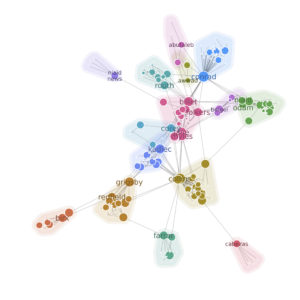
Here’s a look at the community structure in a network where edges indicate email correspondence. Most clusters in the network include one or more government agency heads and task leaders, who have high centrality scores in the network.
All of our code and derived datasets are accessible on my github page: https://github.com/nveldt/fauci-email

Our manuscript can be viewed as a data manual, and also includes a number of interesting findings from our initial analysis. https://arxiv.org/abs/2108.01239
Filed Under: Data, Preprint

New preprint on Hypergraph Homophily

Posted on March 23, 2021 by nveldt

New preprint: Higher-order Homophily is Combinatorially Impossible! Joint work with Austin Benson and Jon Kleinberg.

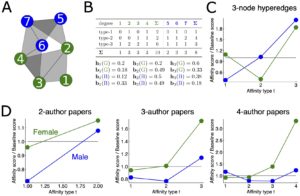
Abstract: Homophily is the seemingly ubiquitous tendency for people to connect with similar others, which is fundamental to how society organizes. Even though many social interactions occur in groups, homophily has traditionally been measured from collections of pairwise interactions involving just two individuals. Here, we develop a framework using hypergraphs to quantify homophily from multiway, group interactions. This framework reveals that many homophilous group preferences are impossible; for instance, men and women cannot simultaneously exhibit preferences for groups where their gender is the majority. This is not a human behavior but rather a combinatorial impossibility of hypergraphs. At the same time, our framework reveals relaxed notions of group homophily that appear in numerous contexts. For example, in order for US members of congress to exhibit high preferences for co-sponsoring bills with their own political party, there must also exist a substantial number of individuals from each party that are willing to co-sponsor bills even when their party is in the minority. Our framework also reveals how gender distribution in group pictures varies with group size, a fact that is overlooked when applying graph-based measures.

Filed Under: Preprint

© 2016–2026 Nate Veldt Log in

Texas A&M Engineering Experiment Station Logo
  • College of Engineering
  • Facebook
  • Twitter
  • State of Texas
  • Open Records
  • Risk, Fraud & Misconduct Hotline
  • Statewide Search
  • Site Links & Policies
  • Accommodations
  • Environmental Health, Safety & Security
  • Employment