

Workshop on Network Science
April 13, 2023
9:00 am – 3:10 pm
Location: Blocker Bldg. room 220
About the event: The TAMIDS Workshop on Network Science will bring together researchers at Texas A&M interested in both theoretical and applied aspects of network science and graph analysis. Network science is a cross-cutting discipline that is broadly focused on studying systems of interconnected objects, examples of which include but are certainly not limited to social networks, power grids, gene regulatory networks, transportation networks, and knowledge graphs. These networked systems and datasets can be represented and analyzed as a graph—a mathematical abstraction involving vertices sharing pairwise connections called edges. Research on graph analysis is pervasive across many different disciplines including statistics, physics, mathematics, computer science, biology, and engineering. Research topics of interest cutting across all of these fields include:
- Generative models for networks
- Statistical inference on networks
- Measuring robustness and resilience in network structures
- Measuring centrality and node importance in networks
- Network visualization
- Temporal network analysis
- Analysis of dynamical processes on networks
- Algorithmic and computational tools for various tasks including graph partitioning/clustering, node classification, link prediction, anomaly detection, and more.
The purpose of this workshop is to foster interdisciplinary conversations and collaborations on various aspects of network science research across researchers at Texas A&M. This includes
- Exposing researchers in applied areas of network science to useful computational, mathematical, and statistical tools for network analysis being developed in other settings
- Introducing researchers in more theoretical areas to open questions, tasks, and networked datasets arising in more applied domains
- Introducing interested students to various aspects of network science research and providing exposure to open research directions
This workshop is organized by Dr. Nate Veldt, an assistant professor in the Department of Computer Science and Engineering at Texas A&M University and an affiliated member of the Texas A&M Institute of Data Science (TAMIDS) and Career Initiation Fellow. He obtained a bachelor’s degree in mathematics from Wheaton College and a PhD in mathematics with a concentration in computational science from Purdue University. His research focuses on combinatorial algorithms and discrete optimization for network analysis and data science.
The workshop is scheduled for April 13, 2023 from 09:00am-3:30pm in the Blocker building room 220.
WORKSHOP SCHEDULE
9:00 – 9:25 am – Coffee/Breakfast
9:25 – 9:30 am – Opening Remarks
9:30 – 10:05 am – Faculty talk: Jesús Arroyo (Statistics)
10:10 – 10:45 am – Faculty talk: Astrid Layton (Mechanical Engineering)
10:50 – 11:10 am – Coffee break
11:10 – 11:45 am – Faculty talk: Victoria Crawford (Computer Science and Engineering)
11:50 – 12:25 pm – Faculty talk: Adam Birchfield (Electrical and Computer Engineering)
12:30 – 1:50 pm – Lunch and Student Poster Session
1:50 – 2:25 pm – Faculty talk: Tim Davis (Computer Science and Engineering)
2:30 – 3:05 pm – Faculty talk: Sharmistha Guha (Statistics)
3:10 pm – Closing remarks and end of workshop
SPECIAL EVENTS
In addition to talks from faculty members across different departments at Texas A&M, the workshop will include two special events during the lunch break.
Student poster session: Students doing research on network science related topics are invited to register to present a poster during the lunch session of the event. There are no specific size restrictions or formatting requirements for posters.
Lightning introduction event: At the end of the lunch break, we will hold a short lighting session where participants will have the chance to introduce themselves in one slide to the rest of the participants. The slide should include your name, affiliation/department, and whatever you would like to include regarding your interests in network science. Here is the organizer’s slide as an example.
To register for either or both of these events, simply fill out the RSVP form.
INVITED SPEAKERS AND ABSTRACTS
Jesús Arroyo
Department of Statistics, https://jesus-arroyo.github.io/
Title: Community detection in multilayer networks
Abstract: Network data often comprise multiple layers, such as different views, time-varying graphs, or independent samples, resulting in collections of networks over the same set of vertices. This talk considers the community detection problem, where the goal is to partition the vertices of the networks into coherent groups. Spectral methods, which are based on the eigenvalues and eigenvectors of appropriately defined matrices, have emerged as a popular tool for analyzing network data due to their flexibility and computational tractability. We present joint spectral methods for community detection in multilayer networks that lead to accurate estimation of community memberships. The methods are illustrated in a time series of flight network data and in the analysis of human brain networks constructed from fMRI.
Astrid Layton
Department of Mechanical Engineering, https://astridlayton.com/
Title: Bio-Inspired Network Design: Using Nature’s Ecosystems to Design Resilience and Sustainable Human Networks
Abstract: Inspiration from nature has produced some fascinating, novel, and life changing solutions for the human world. Most of these bio-inspired designs however have been product based. Taking a systems perspective when we look to nature taps inspirations that can improve the critical networks we depend on. This talk focuses on biological ecosystems in particular, complex networks of interacting species that are able to support individual needs while maintaining system-level functions. These networks offer inspiration for achieving both sustainability AND resilience in the design of our human engineered networks. Quantitative ecosystem descriptors and analysis techniques adapted from ecology enable desirable ecosystem characteristics to be used as design guides for things like industrial resource networks, water networks, supply chains, and power grids.
Victoria Crawford
Department of Computer Science and Engineering, https://people.tamu.edu/~vcrawford/
Title: Submodular Functions in Network Applications
Abstract: Submodularity, a diminishing returns property of set functions, arises in many network analysis tasks. For example, submodular functions appear when identifying the most effective nodes for the spread of information in a social network, when finding key edges whose removal would disrupt a network, or when deciding where to monitor to most quickly detect the spread of some contaminant. In particular, these tasks can be formulated as the optimization of a submodular objective, for which there exists a wealth of scalable algorithms with proven performance guarantees. In this talk I will discuss the network applications of submodularity, and give an overview of existing algorithms available for this interesting class of functions.
Adam Birchfield
Department of Electrical and Computer Engineering, https://birchfield.engr.tamu.edu/
Title: The Electric Grid as A Complex Network: Characterization and Creating Synthetic Datasets
Abstract: The electric grid is a vast network of transmission lines, transformers, generators, and other equipment that delivers bulk electric power to industrial, commercial, and residential customers over a wide area. Growing reliance of society upon this system, along with growing concerns about natural and human-induced extreme event impacts, has driven much interest in understanding this complex network and the associated system resilience and fragility. In this presentation, we will discuss characterizing the electric grid as a complex network and building synthetic datasets for research and development. We will explain the interaction among a number of system metrics from graph theory, network science, computational geometry, and engineering analysis. This characterization underlies the methodology for creating synthetic grids, which are fictitious datasets that provide test cases for research and development, spurring innovation and supporting research reproducibility, since much actual grid data is considered critical energy infrastructure information (CEII) and cannot be published. The synthesis methodology consists of a heuristic balance of graph generation, discrete optimization, and engineering planning emulation to produce high-quality, realistic, large-scale synthetic electric grid test cases.
Sharmistha Guha
Department of Statistics, https://sites.google.com/view/sharmisthaguha
Title: A Bayesian Approach to Network Classification
Abstract: We propose a novel Bayesian binary classification framework for networks with labeled nodes. Our approach is motivated by applications in brain connectome studies, where the overarching goal is to identify both regions of interest (ROIs) in the brain and connections between ROIs that influence how study subjects are classified. We propose a novel binary logistic regression framework with the network as the predictor, and model the associated network coefficient using a novel class of global-local network shrinkage priors. Two representative members from this class of priors, the Network Lasso prior and the Network Horseshoe prior, are implemented using an efficient Markov Chain Monte Carlo algorithm, and empirically evaluated through simulation studies and the analysis of a real brain connectome dataset.
Tim Davis
Department of Computer Science and Engineering, https://people.engr.tamu.edu/davis/welcome.html
Talk title and abstract forthcoming.
Acknowledgements
This workshop is generously funded and made possible by the Texas A&M Institute of Data Science.
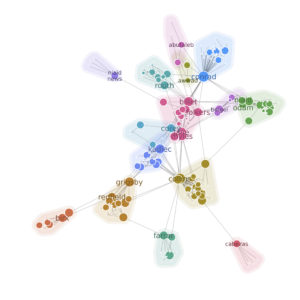
The “TAMIDS” graph word figure was made using David Gleich’s words-in-graphs software.